
“Written in prison, exile and battle, this is the political bible followed by half the world”
In 1903, a 13-year-old-boy named Nguyễn Sinh Cung was expelled from school for political activities. Left with no prospects in his poor home country, he escaped through a job as a mess boy on a French ocean liner. From that day he lived his life on the run, traveling all across the world: from Asia to Africa, from North America to Europe. He worked as a baker in Boston, a kitchen boy in London, a photographer’s assistant in Paris.
Today, this man is better known by his alias: Hồ Chí Minh, the leader of the Vietnamese revolution.
Ho Chi Minh on Revolution is a collection of writings and speeches given by Ho Chi Minh over the course of his life, from 1920 to 1966. It’s the autobiography of a man who was too busy to sit and write one, and the history of a nation from the perspective of a man who gave everything to liberate her.
The book was compiled by an American journalist named Bernard Fall. It begins with a biographical introduction written by Fall, and ends with an interview between him and Ho Chi Minh.
Many of these speeches and writings are appeals to the Vietnamese people. These are the most inspiring. Many are also directives given to the Vietnamese revolutionary forces. These are some of the most educational.
The main thing that leapt out at me in this book was Ho Chi Minh’s unshakable revolutionary optimism.
As he wrote in “French Colonization on Trial”, the conditions of Vietnam during his youth were intolerable: the people were destitute and enslaved, worked to the bone by the French, exploited by the Vietnamese landlords and bourgeoisie, forbidden from education, forbidden to leave the country, addicted to opium and alcohol, and every day beaten, raped, and humiliated by the Occupation. In the First Great Inter-imperialist War (WWI), they were press-ganged on pain of death into the French army. When they migrated to France to rebuild it after WWI, they faced discrimination and brutality.
But despite all this—or because of it—Ho Chi Minh had a vision. Even in the worst times, he saw that his country would someday be free, and he took it upon himself to find out how.
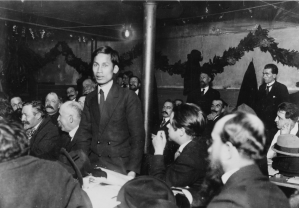
The first section of the book is from Ho Chi Minh’s time in Paris, from 1917 to 1924. Here he discovered the writings of Lenin, about which he wrote:
By reading them again and again, finally I was able to grasp the essential part. What emotion, enthusiasm, enlightenment and confidence they communicated to me! I wept for joy. Though sitting alone in my room, I shouted aloud: ‘Dead martyrs, compatriots! This is what we need, the path to our liberation!’
Ho Chi Minh was deeply inspired by Lenin, who consistently denounced racism and colonialism. This propelled Ho to write about the desperate conditions of the Vietnamese, as well as other oppressed people, like Algerians, Syrians, and African Americans (“It is well known that the Black race is the most oppressed and most exploited of the human family”). Ho Chi Minh understood the common roots of these struggles.
While in Paris, Ho Chi Minh also struggled against the right-wing of the French socialists who, following the line of the Second International, downplayed the colonial question. Ho found his place in the left-wing of the French Socialist Party, and helped found the French Communist Party. This party would later join the Third International, or Commintern.
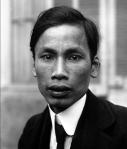
From 1924-1930, Ho was active in the Commintern, where he agitated on the liberation of colonies as the key to overthrowing capitalism. He even studied and taught at the “University of the East” in Baku.
This school in the USSR was a place of cultural exchange, where people of Asia came to study science, mathematics, world literature, philosophy, art, and scientific socialism. The students were treated with full dignity and respect, not as colonial subjects; a rare experience which deeply impressed Ho Chi Minh. For the rest of his life, he spoke of the USSR as a force of justice and democracy on the side of the oppressed people of the world.
“Colonial atrocities have prepared the soil; it is for socialists to sow the seeds of revolution.”
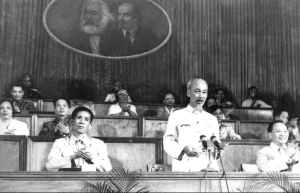
In 1930 Ho Chi Minh returned to Vietnam. He united the communist parties of North, Central, & Southern Vietnam into the Communist Party of Indochina to lead the emerging revolution of workers and peasants.
When France was defeated by Germany and “gave” Indochina to Japan, the Japanese fascists began attacking Vietnam. In answer, the Party joined the Democratic Front which brought the national bourgeoisie into the fight against the Japanese.
Ho Chi Minh called on his people to unite and rise up against these twin adversaries who were both weakened by ongoing war, forming the “Revolutionary Front for the Independence of Vietnam”, or Viet Minh.
In 1943 Ho was imprisoned by Chiang Kaishek’s reactionaries in China. While in prison, he wrote this famous poem:
“People who come out of prison can build up the country.
Misfortune is a test of people’s fidelity.
Those who protest at injustice are people of true merit.
When the prison doors are opened, the real dragons will fly out.”
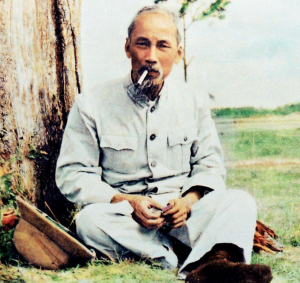
And the real dragon did fly out. Ho Chi Minh was soon freed by his Chinese communist comrades, and he returned to Vietnam. In 1944, Ho called for a general insurrection to finish off the Japanese.
In 1945 he penned the Declaration of Independence of the Democratic Republic of Vietnam, where he quoted both the American Declaration of Independence and the Declaration of the French Revolution, calling back to these democratic ideals to show the hypocrisy of imperialism.
“Nothing is more precious than independence and liberty. It is better to sacrifice everything than to live in slavery.”
Several decades of bitter struggle followed. As soon as France was freed from the Nazis, they rushed back to Vietnam to invade and enslave her again. The people of Vietnam did not just have to free themselves from feudalism and capitalism; they had to fight the French as well. And later, the Americans.
“Our resistance will be long and painful, but whatever the sacrifices, however long the struggle, we shall fight to the end until Vietnam is fully independent and reunified.”
Another thing that I find remarkable about Ho Chi Minh is his brilliant strategic mind. He grasped deeply the principles of Marxism, and knew intimately the ways of the imperialists. He was able to correctly analyze changing material conditions and recommend different methods at different times. He was a brilliant tactician who taught his comrades to turn disadvantage into advantage.
It is fascinating to see the progress of the resistance over the years. This is one reason why I rate this book higher than a typical biography or history. It shows not just the strategies, but the reasoning and principles behind each new strategic turn, and the conditions that precipitated them. I got to see how a revolutionary creatively responds to new challenges without the benefit of hindsight.
“You will kill ten of our men for every one we will kill of yours. But in the end, you will tire of it first.”
During the decades of struggle, Ho Chi Minh proudly proclaimed the victories and strengths of the resistance, demonstrating his unswerving faith in the people to liberate themselves. But he also practiced criticism and self-criticism. This is a unique feature of Marxist-Leninism and no doubt one of the strengths of the Vietnamese resistance.
“The future of the Vietnamese is as bright as the sun in spring. Overjoyed at the radiance of the sun in spring, we shall struggle for the splendid future of Vietnam, for the future of democracy, world peace and socialism. We triumph at the present time, we shall triumph in the future, because our path is enlightened by the great Marxist-Leninist doctrine.”
The later writings also deal with the particulars of building socialism, and are very instructive. Ho Chi Minh considered everything: how communist party members should treat the people well; how to correct mistaken ideas and improve the style of work; how to make the party more efficient; how to run elections and formulate correct policies; how to go about land reform; how to raise literacy rates and bring healthcare to the people; how to build infrastructure (and even destroy it!); and even how to elevate and enrich the culture of the people.
“The revolution is the work of the masses, not that of a few heroic individuals. The success of our party lies in the fact that it has organized and developed the boundless revolutionary power of the people and led the people in battle under the invincible banner of Marxism-Leninism.”
Ho Chi Minh loved his people deeply, and had great faith in them. He was deeply concerned with the welfare of children, the old, the sick, and the poor; and with the liberation of women. He was a true internationalist who did not hate the French or American people, but instead made appeals to proletarian unity. He resoundingly decried injustice, but answered treachery with a smile and a tongue-in-cheek quip. (Really, some parts of this book are quite funny.)
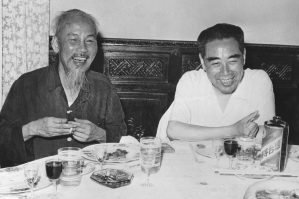
2025 was a hard year. A really hard year. And 2026 is shaping up to be even harder. But this battered little book was a constant companion to me in the darkest times. Whenever I opened its yellowed pages, it was like a light of pure hope was shining on me. Reading how the brave Vietnamese people raised themselves out of such terrible oppression steeled my nerves and kindled my heart.
Ho Chi Minh, though I never met him, has been my great teacher. He has taught me that hardship is not defeat, no matter how terrible nor how long endured; instead, it is the crucible of resistance. He taught me that when the people decide to come together and stand up, when their leaders are bold and true, nothing can stop them. He taught me that Marxism-Leninism is the true path to global liberation from capitalism; and that true communists must be “the mules and oxen of the people”.
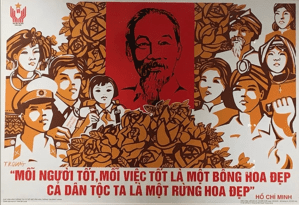
Here are 10 must-read works contained in this volume.
- The Path which Lead me to Leninism
- Report on the National and Colonial Questions at the Fifth Congress of the Communist International
- French Colonization On Trial
- Appeal Made on the Occasion of the Founding of the Communist Party of Indochina
- Twelve Recommendations
- Appeal for Patriotic Emulation
- The Imperialist Aggressors Can Never Enslave the Heroic Vietnamese People
- Leninism and the Liberation of Oppressed Peoples
- Speech Opening the Third National Congress of the Vietnam Workers’ Party
- Our Entire People United as One Man are Resolved to Defeat the U.S. Aggressors
“Our mountains will always be here. Our rivers will always be here. Our people will always be here. The American invaders defeated, we will rebuild our land ten times more beautiful.”
There are so many jewels of wisdom contained in Ho Chi Minh’s writings that it is impossible to list them all here. You’ll just have to read it yourself, and be transformed!
 El choque de olas
Leave a comment