In order to build socialism, first and foremost, we need to have socialist people who understand socialist ideology and have socialist values. —Ho Chi Minh
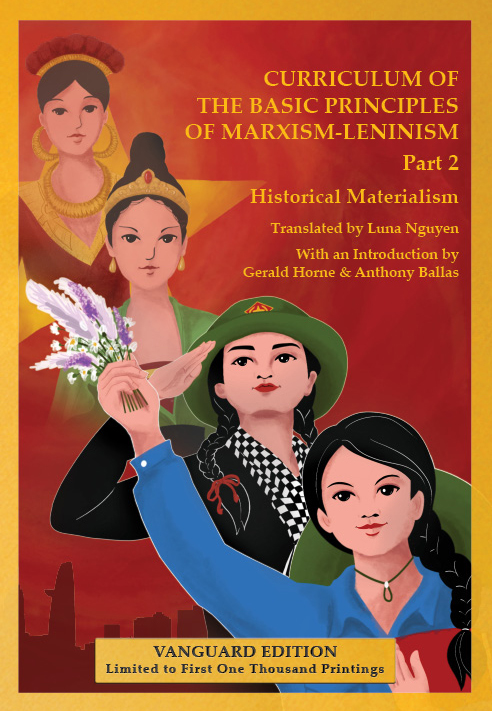
This is the second part of a series of Vietnamese college textbooks that have been translated into English by Luna Nguyen.
The first volume covers Dialectical Materialism, and the third volume, which has yet to be completed, will cover Scientific Socialism. The first book isn’t absolutely essential to understand the second.
The books all have introductions and extra essays by other authors, and the text is interspersed with lots of lengthy annotations and illustrations to expand on the core text. (These are helpful because the textbooks are extremely dense and were written for Vietnamese college students who will have already studied this material in highschool.)
So what is “historical materialism”? In short, it’s the application of dialectical materialism to human society and development. It’s the scientific study of human life and human history.
(Dialectical materialism is a way of seeing the world where all things are defined by mutually-influencing relationships (dialectics), and all change is driven by contradictions within subjects and between subjects. The world is made up of dialectics where one subject defines the other, and the other subject impacts back on the first. The most important dialectic is matter and consciousness: matter exists first, and it determines consciousness, while consciousness impacts back on matter.)
According to historical materialism, the whole history of human development is class struggle. As classes struggle, some classes win out and others are eliminated. The driving force of this development is not ideas, but rather the material existence of the people, and the internal contradictions of this material side of society. This is how new societies overtake the old.
Following are some brief explanations of the concepts in this book.
- “The law of suitability between the relations of production and the development of the productive forces”. In every economic system, the relations of production (who owns the means of production and the products, and who produces) must be suitable to the productive forces. It must aid their development and not impede it.
As the productive forces develop, they eventually become unsuitable to the relations of production, which must be replaced in order to allow further development. - “Base and superstructure”. The “base” is the economic structure of society, all the modes and relations of production. The “superstructure” is the legal, political, and cultural side of a society and its “social consciousness”. The base determines the superstructure, while the superstructure can impact back on the base.
- “Social being and social consciousness.” Social being is the material life and material conditions of society, including subjective factors (mode of production) and objective factors (natural conditions, geography, population levels). Social consciousness is the ideas and mental life shared within and between groups of human beings. Social being determines social consciousness.
- “Class struggle and social revolution”. Classes are defined by their role in relations of production and how they acquire their wealth. Classes are products of historical context. The state is an organ that arises from class society to enforce the domination of one class over others. Social revolution is when a progressive oppressed class, which is more suitable to emerging productive forces, becomes the new ruling class and brings a new mode of production.
This is how society passed from the slave societies of antiquity, to feudalism, to capitalism, and finally to socialism. The difference is that in socialism, the ruling class is the majority, and thus has the task of ending the grand epoch of class society. - The working masses are the driving force of all revolutions and reforms in history. No revolution or reform can happen if it doesn’t come from the interests and aspirations of the masses.
These concepts are applied to specific historic and modern examples to illustrate and clarify them, and they are also applied to the work of making revolution and building a new socialist society.
The main text is followed by eleven appendices which summarize the main concepts and apply them to the Vietnamese context.
This book has been fundamental to my ongoing political study. I highly recommend it to every socialist.
It clearly explains the scientific method of analyzing a society at a given point in its development, which is a necessary skill when undertaking revolution and building socialism. It’s no understatement to say that this book changed the way I see the world.
 El choque de olas
Leave a comment